
Although I didn’t realize it, I have always used mini museums in my classrooms. It started with teaching preschool, where themes ruled my planning time, and artifacts and realia ruled the classroom. Little children need lots of hands on manipulation of items they are studying in order to make the concrete connections needed to learn new concepts. I first consciously thought about setting up mini museums in my classroom when I began using the “Traveling Trunks” from Bowers Museum. This museum had been a part of my childhood, as it was within walking distance of my elementary school. I remember visiting with various classes, my Brownie troop, and my family. I loved walking through the cool, dark rooms filled with beautiful baskets and clothing created by native Californians. I imagined myself wearing the soft deerskin tunic and pants worn only for ceremonial occasions. Even as a young child, that museum took me to another place and time. As a teacher, I was so excited to find that this local museum had trunks filled with period artifacts, available to classroom teachers throughout the county, to use in their classrooms. The museum delivered and picked up the items that were intended to be handled by elementary school children. What a WONDERFUL program! After borrowing my first trunk, a classroom museum became a cornerstone of every place I worked, both as a classroom teacher and as a support teacher.
In my situation, the museum was a permanent corner of the classroom which changed with the themes being studied. Like in most museums, a mural formed the backdrop for the center. As we studied new content, the mural was changed to reflect the new themes, building upon what was learned previously. Images and short, summarized reports were written, printed in large fonts, and hung on the mural to explain information about items on the mural and things found in the mini museum. Although I usually wrote a couple of examples to demonstrate for the children, these were quickly replaced by student writings, drawings, and photographs. Originally, the museum table contained artifacts I purchased, but as the years passed, grew to contain far more items created by previous students than purchased from a store.
Early on, I believed I would be taking away from the creativity of succeeding classes if I shared the artifacts created by previous classes in the mini museum, so I started from scratch each year. After a few years of getting the same ole stuff from each class, I decided to try starting the museum with artifacts created by previous classes. That’s when things really began to take off! From then on, not only did my museum materials grow, the quality of student created materials skyrocketed! I began to have so many images and wall display reports that I had a file box full to use as reference material. Each unit began with an exciting display that prompted student questions, lead to student research, and facilitated the discovery of new information, and this time the children were starting where the last class left off and moving on from there. Over the years I had an amazing collection of “museum” materials on about 30 different themes such as Japan, dinosaurs, native Americans, the gold rush, America’s old west, colonial America, insects, volcanoes and earthquakes, rocks and minerals, electricity, magnets, Hawaii, California, archeology, and a bunch more. Sadly, all of those materials were destroyed in a hurricane in the late 1990s. Cleaning the smashed and sogged out remains of about 20 years of student and teacher productivity was very painful, but it’s always good to start with a clean slate, too. I had a lot fewer boxes in my next move!
A classroom mini museum is one of my favorite teaching tools and something that is not difficult to start in any classroom. The students are the building blocks of the display. You probably already have the basics to get started right away! If you have never worked with a wall-sized mural, you may want to start with something smaller as you discover what works best for you. I once used a series of three small murals (about 3’x4′ oval shapes) to compare three different climate zones found in California: deserts, mountains, and the seacoast. Each mural was placed on a wall panel, and the information researched, collected, and photographed by the students was displayed around it. Later these murals were used for backdrops to photograph student created artifacts about the life of the native Californians within each climate zone. The photographs were then used to illustrate a book written by the class about California’s first people. A mural of this size is very easy to manage and a good choice for “beginners.”
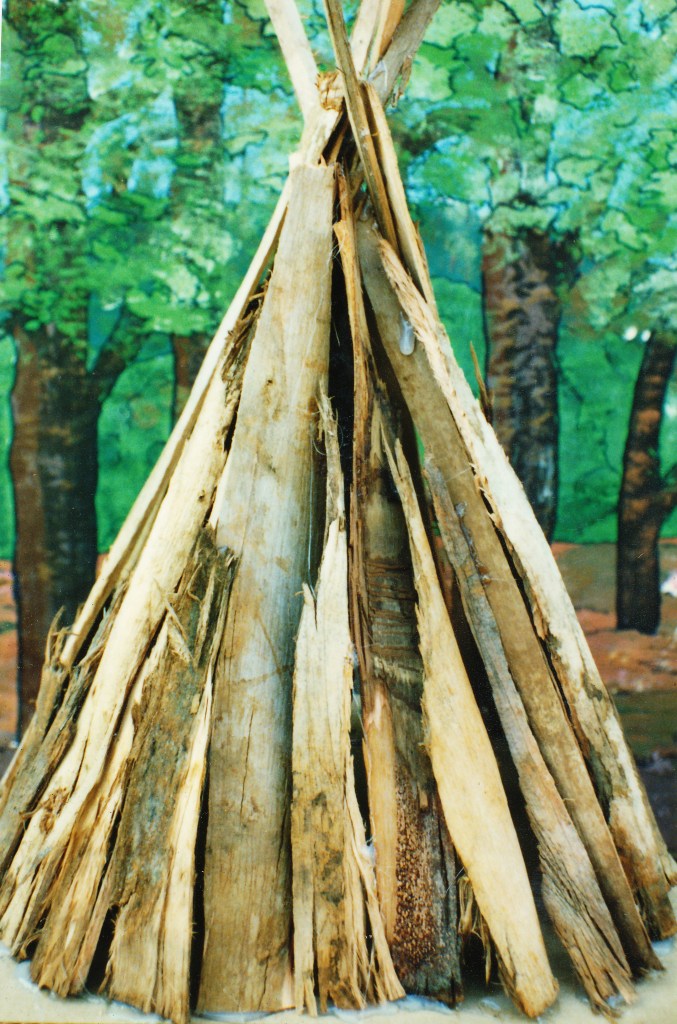
| The background is a mural painted by third and fourth graders. The foreground is a student made plank wickiup representative of native Californians in woodland regions. |



 Thematic Teacher